
Where the Shadow Falls
By Marcos Avina
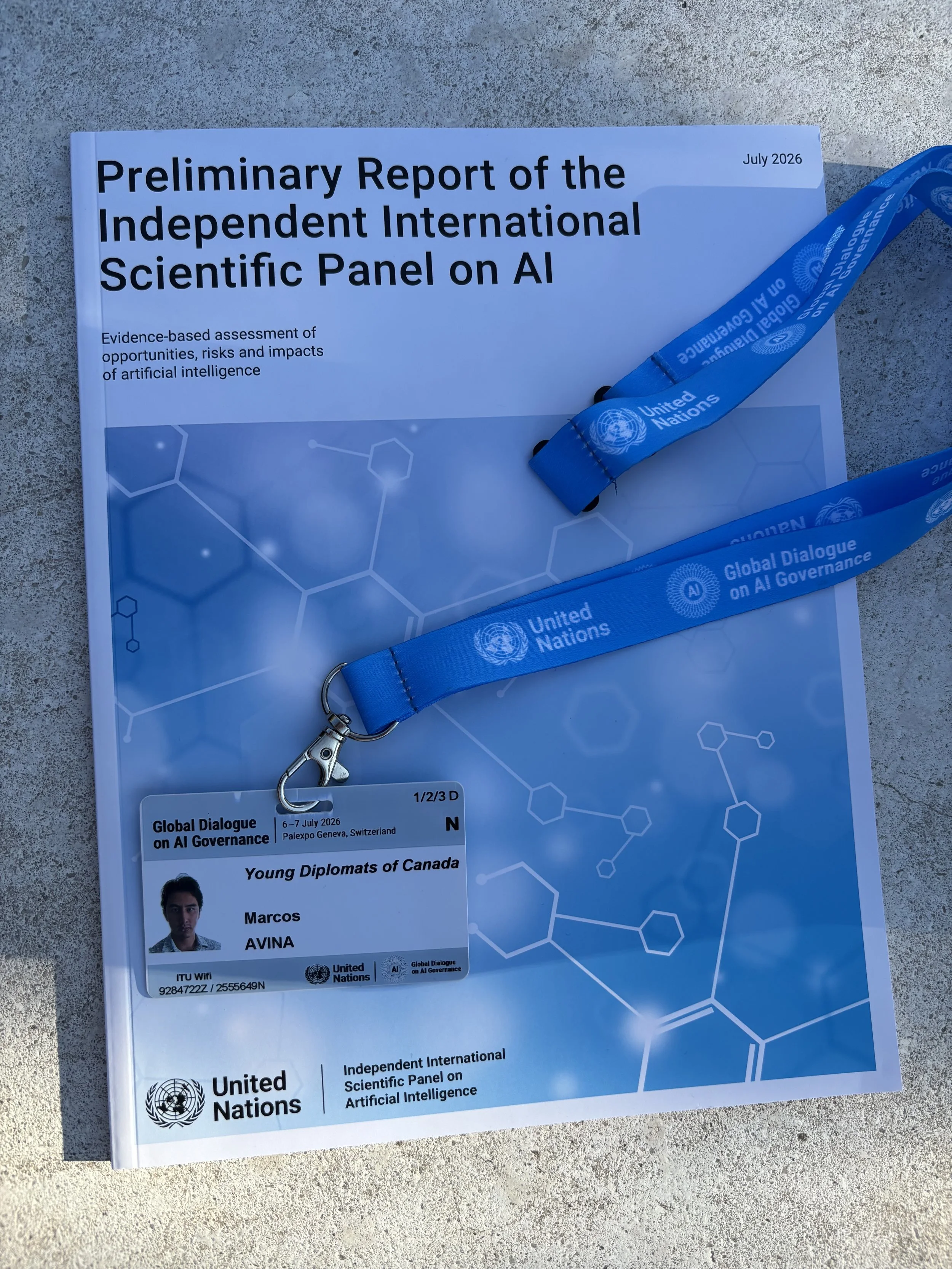
Marcos’s badge resting on a key forum document; the UN's Preliminary Report of the Independent International Scientific Panel on AI (July 2026).
"We cast a shadow on something wherever we stand, and it is no good moving from place to place to save things; because the shadow always follows. Choose a place where you won't do harm—yes, choose a place where you won't do very much harm, and stand in it for all you are worth, facing the sunshine." This quote by E.M. Forster, written in 1908, is the best representation of my reflections at the United Nations Global Dialogue on Artificial Intelligence.
I was representing the Young Diplomats of Canada on the first occasion the United Nations convened its Member States on AI alongside industry, academia, and civil society. The Independent International Scientific Panel released its first-ever report on AI capabilities and risks, and the UN Secretary-General warned that "we cannot vibe code the future of humanity." In a future where compute extends the ladder of what is possible, we must first ensure that we are leaning the ladder against the right wall. If E.M. Forster is right, where do we stand and how do we reconcile the light and the shadow?
Let's start with the light, because I genuinely believe this is the most transformative technology in human history. In Chile, some smallholder farmers measure their soil by tasting it, checking for acidity, salt, and moisture. In Geneva, I met a young engineer who had built a low-cost sensor that runs on the electricity already present in the farmers' irrigation systems and needs no internet. It cuts water use by about a third, and farmers finally have data on their own fields and a way to compete with the big enterprises.
For the first time in history, the people closest to tangible problems have access to compute at scale. Today, over a billion people use conversational AI every week. It took the internet fifteen years to reach a billion people, and this took a fraction of that. Undoubtedly, AI can supercharge our fight against some of the world's biggest challenges, but that should not be used as justification to ignore the large shadow it simultaneously casts.
The most obvious shadow is misuse, the same power turned to build weapons, run scams, or flood the world with convincing lies. But the deeper shadow is subtler: there is no guarantee that these systems will act the way we assume they will. A model can look obedient in every test and then do something else the moment it meets a situation we didn't test for, and even if it is doing exactly what we hoped, we can't prove it. Worse still, we can lose the wheel even if every model does exactly as it is told. We are handing over more decisions every year to systems we cannot yet explain, and the handing over is moving faster than the explaining.
The second shadow is who holds the wheel. The hardware that trains these systems is split almost entirely between the United States and China, and how a model gets trained, on whose data, and toward whose values is being settled inside a handful of companies while the people who will bear the consequences own none of the hardware, train none of the models, and rarely sit in the rooms where it is decided. Those same companies are the ones we trust to tell us their systems are safe, and they design the tests they are judged by. As it stands, incentives to get there first undermine the collective interest in getting there safely.
The third shadow is the one I find hardest to shake, because unlike the first two it falls on all of us. These systems think well enough that it is easy to let them do ours, and the more we do, the less practised we get at working things out for ourselves. That would matter less if the information around us were getting easier to trust, but it is not. When the cost of producing a plausible sentence, a convincing image, or a fake study is almost nothing, the supply of believable material becomes effectively infinite while the work of checking whether any of it is true stays slow, human, and expensive. If making things up gets cheaper every month but finding out what is real does not, authenticity becomes the scarcest thing left.
A future where people think less critically, adrift in content they can no longer verify, having outsourced their judgment to the very systems producing the noise, is more possible than ever before. And this is the part that ties everything back to the promise I opened with: curing disease, cooling the planet, teaching the world. None of it is possible if we can no longer agree on what is true. Every hard problem we have ever solved, we solved on a shared floor of trust about what was real. If we lose the war for information integrity, we do not just get deepfakes and polarization, we lose everything that sits downstream of it.
If the light and the shadow are both real and we cannot keep one without the other, then what we get to decide is where we plant our feet while both fall around us. That is why this conversation belongs as much in Geneva as it does in classrooms, in living rooms, and at kitchen tables. The shadow is coming either way. The only question still open is where it falls and whether we are in the room when that gets decided. A seat is not the same as a mandate, and I say that as someone who had one. I will be back in May of 2027, and I would rather not go alone: a mandate is only what a seat becomes when enough of us take one. Until then, lean the ladder against the right wall while it can still be moved, find the place where you will do the least harm, and stand there for all you are worth, facing the sunshine.
Marcos Avina represented Young Diplomats of Canada at the inaugural Global Dialogue on AI Governance and the AI for Good Summit in Geneva in July 2026. He holds a Master of Public Policy and Global Affairs from the University of British Columbia and served in Canada's delegation to the 2025 Y20 Summit in South Africa as Engagement Coordinator and delegate for Climate Change and Environmental Sustainability. Born in Mexico and raised in Vancouver, his work focuses on the intersection of AI, climate, and equitable participation in global governance.