
Stop Asking Youth to Show Up; Start Building Systems They Can Stay In
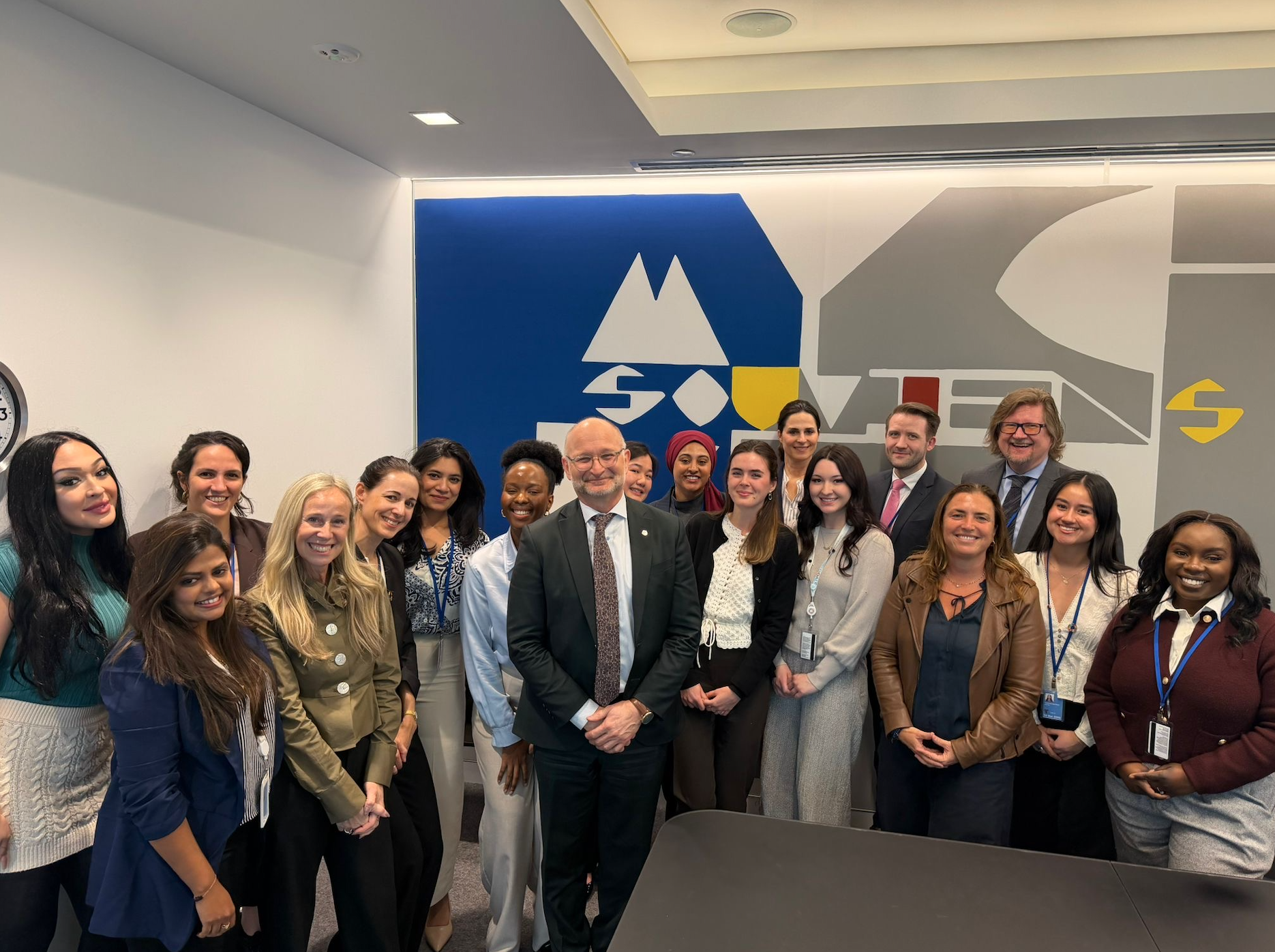
Daniela pictured with Ambassador David Lametti, Permanent Representative of Canada to the United Nations, alongside Young Diplomats of Canada CSW70 and UNA-Canada delegates at the side event “She Leads, She Makes the Shift: Young Women Driving Justice, Equity, and Systemic Change,” where she participated as a panelist.
This past March, at the 70th Session on the United Nations Commission on the Status of Women (CSW70), the UN Youth Office launched eleven Core Principles for Meaningful Youth Participation. These Principles seek to provide a framework to ensure that youth engagement in international policymaking is intentional, equitable, and accessible.
Drafted in response to the Meaningful Youth Engagement in Policymaking and Decision-Making Processes Policy Brief, these Principles mark an important step forward. They articulate a standard for decision-making that all institutions should strive for, especially if we intend to move towards an intergenerational future of mutual accountability.
However, as a young person navigating these spaces, a critical gap persists.
It seems that the UN's Core Principles for Meaningful Youth Participation will remain performative until international institutions resolve to structurally embed young people within decision-making processes, rather than alongside them.
Institutions have become increasingly effective at inviting youth into conversations, but far less willing to redesign the system that determines whose participation is sustained, funded, and taken seriously.
Through my participation at CSW70 as a youth delegate and my work with Young Diplomats of Canada (YDC) over the past three and a half years, I have seen first-hand the profound expertise and urgency young people bring to global forums. Yet, these engagements often occur in siloes, structurally isolated from the spaces where decisions are actually negotiated.
Take, for example, when it was YDC's turn to mirror Canada's presidency as the official engagement group for the G7's 2025 Youth (Y7) Summit. While we were able to welcome the G7 Sherpa to the Summit and secure diplomatic representatives as keynote speakers, the Y7 Summit was organized separately from the official G7 Leaders’ Summit in Kananaskis, with no indication if the negotiated communique was taken into consideration.
Similarly, at CSW70, a youth town hall was convened only after key negotiations among member states had already concluded. While these initiatives signal that youth participation is welcomed in theory, they also reveal the limits of that participation in practice: young people are invited into parallel conversations rather than embedded within the processes where political outcomes are shaped.
At the same time, participation often comes with a cost. Many youth delegates remain entirely self-funded, relying on personal savings or grassroots fundraising simply to access these international spaces. When participation depends on financial capacity, inclusion becomes a privilege rather than a universal right. Consequently, the perspectives most urgently needed in global decision-making are often excluded alongside the marginalized communities they represent.
Even the substantive scope of these conversations becomes narrowed by institutional structures. At CSW70, I frequently found myself questioning the absence of genuine cross-sectoral dialogue. Youth-led organizations, grassroots NGOs, Indigenous advocates, and smaller state delegations are frequently treated as complementary voices rather than integral actors in policymaking spaces. Yet, these are often the groups closest to the lived realities global institutions claim to address.
Even for those who overcome these socio-economic barriers, engagement is rarely sustained. There is often disheartening ambiguity regarding how youth contributions are carried forward after flagship summits conclude. Participation becomes temporary and consultative rather than continuous and integrated, leaving young people to navigate systems that were never designed to retain them.
At one CSW70 side event addressing technology-facilitated gender-based violence, I listened to Chanel Contos, founder of the youth-led, Australian-based NGO Teach Us Consent, speak on the systemic failures to protect young people online. Her insights were acknowledged, praised, and framed as examples of youth leadership. But once the panel ended, so did the conversation. The applause was immediate; the structural follow-through was not.
Serious reform is needed before youth can meaningfully and sustainably participate in global decision-making. Representation alone is not enough. Young people should not be invited merely to share personal stories or symbolize inclusion; they must be treated as long-term stakeholders whose insights actively shape policy formulation, implementation, and accountability—priorities that the UN Core Principles for Meaningful Youth Engagement shed a light on.
Achieving this requires sustained investment in accessible pathways for continued engagement beyond flagship events like at CSW70. This means institutionalizing mentorship opportunities, equitable intergenerational partnerships, fully-funded participation streams, and transparent mechanisms for evaluating policy impact over time.
“The fundamental challenge facing global governance is no longer whether young people deserve a seat at the table. It is whether institutions are willing to redesign the table itself.”
The fundamental challenge facing global governance is no longer whether young people deserve a seat at the table. It is whether institutions are willing to redesign the table itself. Until that systemic shift occurs, intergovernmental processes must, at a minimum, employ the UN Core Principles as a baseline tool to reshape their understanding of the power and potential youth hold in architecting our shared future.
Daniela Valenzuela Neto is a Brazilian-Peruvian-Canadian youth advocate and former Executive at Young Diplomats of Canada (YDC), where she advanced youth participation in global governance with a focus on equitable decision-making. She became YDC’s youngest executive at 18 and has represented Canadian youth in international policy spaces, including the G20 Youth Pre-Summit and Canada’s 2025 Y7 Summit. In 2025, she received the King Charles III Coronation Medal for her contributions to youth advocacy and inclusive decision-making.